


Luggage Capacity Guide
Match Your Group to the Right Vehicle
Luggage capacity isn't a guessing game; it's a logistics equation. Ensure a seamless journey for your group by understanding the exact storage architecture of our private bus rental fleet.
Luggage Capacity Data by Vehicle Class
Whether you are coordinating a heavy-duty airport transfer or a multi-day corporate roadshow, the primary variable dictating capacity is the presence of an undercarriage hold.
*Note: Baseline data assumes a standard large suitcase dimension of 70 x 50 x 30 cm. Soft holdalls and backpacks compress efficiently and rarely impact absolute capacity limits.
Vehicle Capacity Explained & Strategic Selection
23-Seater Minibus: The High-Density Cabin
The 23-seater operates on a shared-space model. Luggage is stored inside the cabin via overhead racks and a collapsible rear seating section. Because there is no separated cargo hold, luggage and passengers compete for the exact same footprint.
⚠️ The Logistics Rule
If you book for 23 passengers and each brings a large checked suitcase, a minibus will fail to fit your load. Choosing a minibus based strictly on passenger headcount - without factoring in cargo volume - is the most common critical error in bus charter capacity planning.
45 & 49-Seater Coaches: The Cargo Separation Model
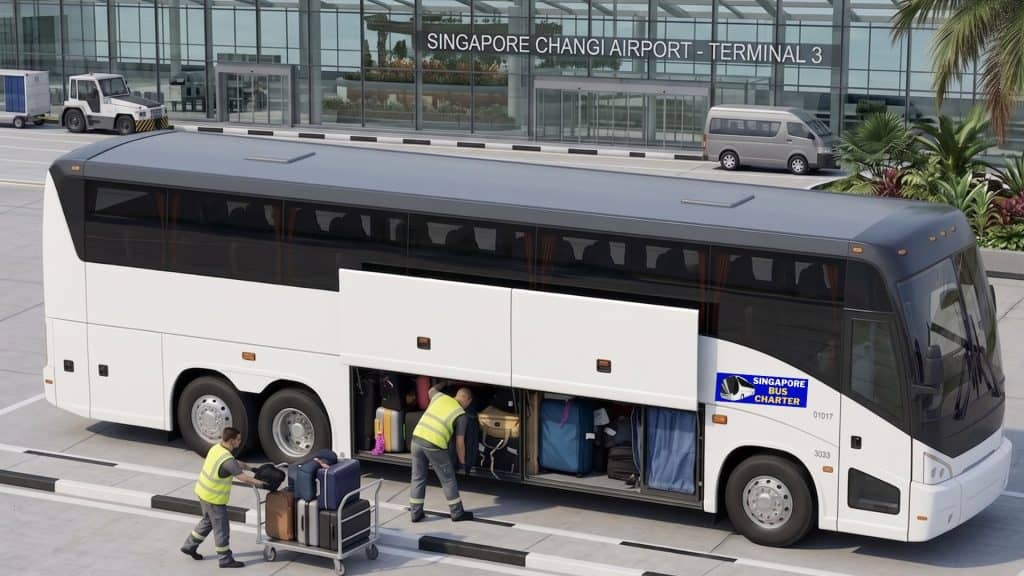
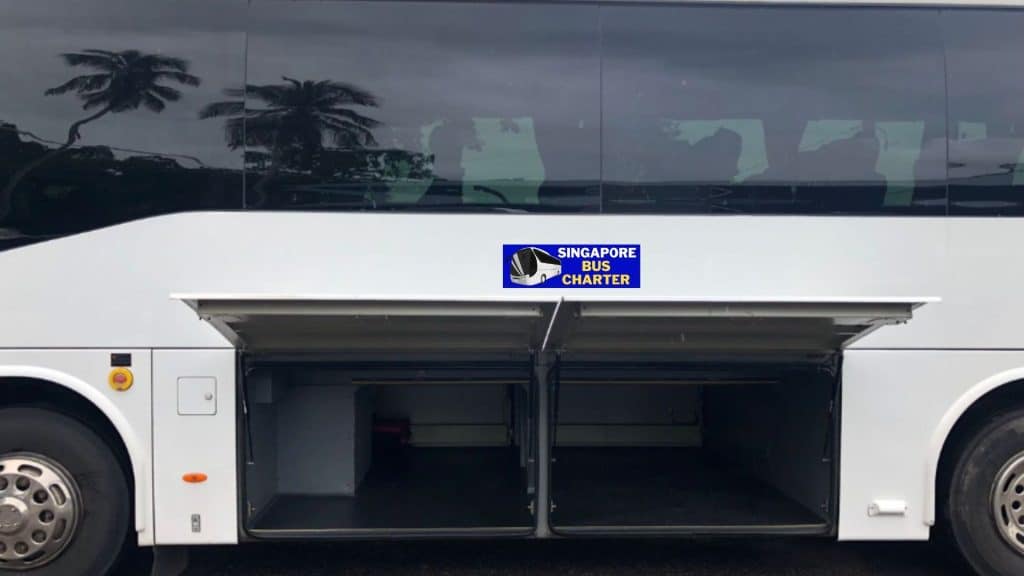
Heavy-duty coaches utilize a separated logistics model: a side-loaded undercarriage hold isolates cargo from the passenger cabin. This keeps the interior clean, maintains ride comfort, and allows you to max out passenger seating without compromising on luggage.
We deliberately route large international groups toward the 49-seater coach because its slightly larger hold volume provides a crucial buffer when every passenger carries a large checked bag plus a carry-on.
Oversized Cargo Declarations
Non-standard items require upfront declaration so we can adjust our vehicle allocation algorithms.
- Golf Bags: Hold-compatible in 45/49-seaters (typically 6 to 8 bags). Declare the exact count.
- Prams & Strollers: Fully compatible across all vehicles when folded.
- Wheelchairs: Foldable models clear the coach hold easily. Motorized require custom consultation.
- Bicycles: Highly inefficient for standard holds. Contact us to verify feasibility.
- Boxed Goods: Heavy corrugated boxes consume hold volume significantly faster than suitcases. Supply an exact box count.
Optimization Tips for Heavy Transfers
- Upsize on the Margins: Operating at 100% seat and 100% cargo capacity simultaneously is where delays happen. Upgrade to the next vehicle tier if you are at the limit.
- Provide Hard Data: We need two distinct data points for an accurate quote: exact passenger headcount and exact total bag count.
- Split the Load: If a single coach cannot safely accommodate the weight/volume, we will engineer a split-load across two vehicles.
- Optimize Packing: Soft-sided duffels compress; hard-shells do not. Gaps between rigid suitcases result in lost volumetric space.
FAQ: Bus Charter Luggage Capacity
Does a 23-seater bus have a luggage hold?
No. The 23-seater minibus utilizes shared cabin space via overhead racks and fold-down rear seats. It lacks an undercarriage hold. If your group is carrying standard checked luggage, a 45 or 49-seater coach is required.
What is the functional difference between the 45 and 49-seater for luggage?
Both operate with undercarriage holds. However, the 49-seater provides a marginally larger cargo volume, making it the strategic choice for international arrival groups carrying heavy or oversized luggage.
Do I need to declare my luggage in advance?
Absolutely. Headcount and total bag count are mandatory data points. Supplying both guarantees we deploy the correct vehicle architecture and eliminates day-of-transfer disruptions.
Book with Strategic Logistics in Mind
Provide your passenger count, dates, and total luggage volume. We will run the numbers and deploy the right asset.